A/C cold at speed but warm at stoplights usually points at airflow across the condenser, often a weak cooling fan. Test before you add refrigerant.
Keep Orlando's Finest in your Google results
Need It Fast?
- At speed the air is free, at idle the fan does the work
- Orlando's normal July low beats its normal January high
- Recharge cans are legal but can't find a leak or a bad fan
- Paid A/C work requires an EPA certified tech
- Pressures, fans and a leak check come before refrigerant
It is the most Orlando car complaint there is. Ice cold at 60 mph on I-4, then warmer and warmer sitting at a light on Colonial. Most people assume it needs a recharge. Often, it doesn't.
A/C is one of the most common calls a mobile mechanic gets in Central Florida, and this symptom has a specific cause worth knowing before you buy a can of anything.
Why Speed Changes Your A/C
Your A/C does two jobs. It pulls heat out of the cabin, and it dumps that heat outside through the condenser, the radiator-like panel at the very front of the car.
To dump heat, the condenser needs air moving across it. At highway speed that air is free, because the car's own motion pushes it through the grille. Stopped at a light, there is no motion. All the airflow has to come from an electric cooling fan behind the condenser.
If that fan is weak, slow, or dead, the system can't shed heat at idle. Pressure on the high side climbs, the system cools less, and the air at your vents warms up exactly when the car stops moving. Drive off and it gets cold again. That pattern points hard at airflow.
Low refrigerant can cause warm air too, but it usually shows up as weak cooling at every speed, not just at lights. That is why the only honest answer is a test, not a guess.


Why Orlando Exposes a Weak Fan
A tired fan can hide for years in a cool climate. Orlando finds it in one summer.
The National Weather Service puts Orlando's normal July high at 92 degrees and the normal July low at 73, using 1991 to 2020 records. Its January numbers show a normal high of about 72. Read that twice. A normal July night in Orlando is warmer than a normal January afternoon.
So the A/C here runs hard, for months, often in stop and go traffic. Hot outside air makes the condenser's job harder, and idling in traffic takes away the free airflow. That is the exact moment a weak fan gives up.
Orlando Never Gives Your A/C a Night Off
Normal temperatures, 1991 to 2020, in degrees Fahrenheit.
Why the Recharge Can Shortcut Backfires
Recharge cans are legal for your own car. The EPA lets people without certification buy small cans of approved car A/C refrigerant, two pounds or less, as long as the can has a self-sealing valve and a unique fitting. Legal does not mean it fixes anything.
A can with a gauge tops up pressure without asking where the refrigerant went. If there is a leak, you are renting cold air by the week. If the real fault is the fan, you just added refrigerant to a system that wasn't low. Overcharging raises pressures that are already too high at idle. Either way, the compressor takes the abuse, and the compressor is the most expensive part in the system.
There is a pro side to this rule too. The EPA's car A/C program says anyone who repairs or services a car A/C system for pay has to be trained and certified, and has to use approved refrigerant handling equipment. Ask whoever works on your A/C about that.
What a Real A/C Diagnosis Checks
- Fan at idle
With the A/C on and the car stopped, the condenser fan should run. A fan that is slow, noisy, or off is the first suspect. Then its fuse, relay and wiring.
- Pressures on both sides
Gauges on the low and high side, at idle and at higher engine speed. High pressure that drops when airflow improves points at the fan.
- Compressor engagement
The compressor should cycle on and stay on long enough to cool.
- Leak check before refrigerant
If the system is low, find out why before adding anything.
- Vent temperature
A thermometer in the center vent, before and after, so you can see the fix work.
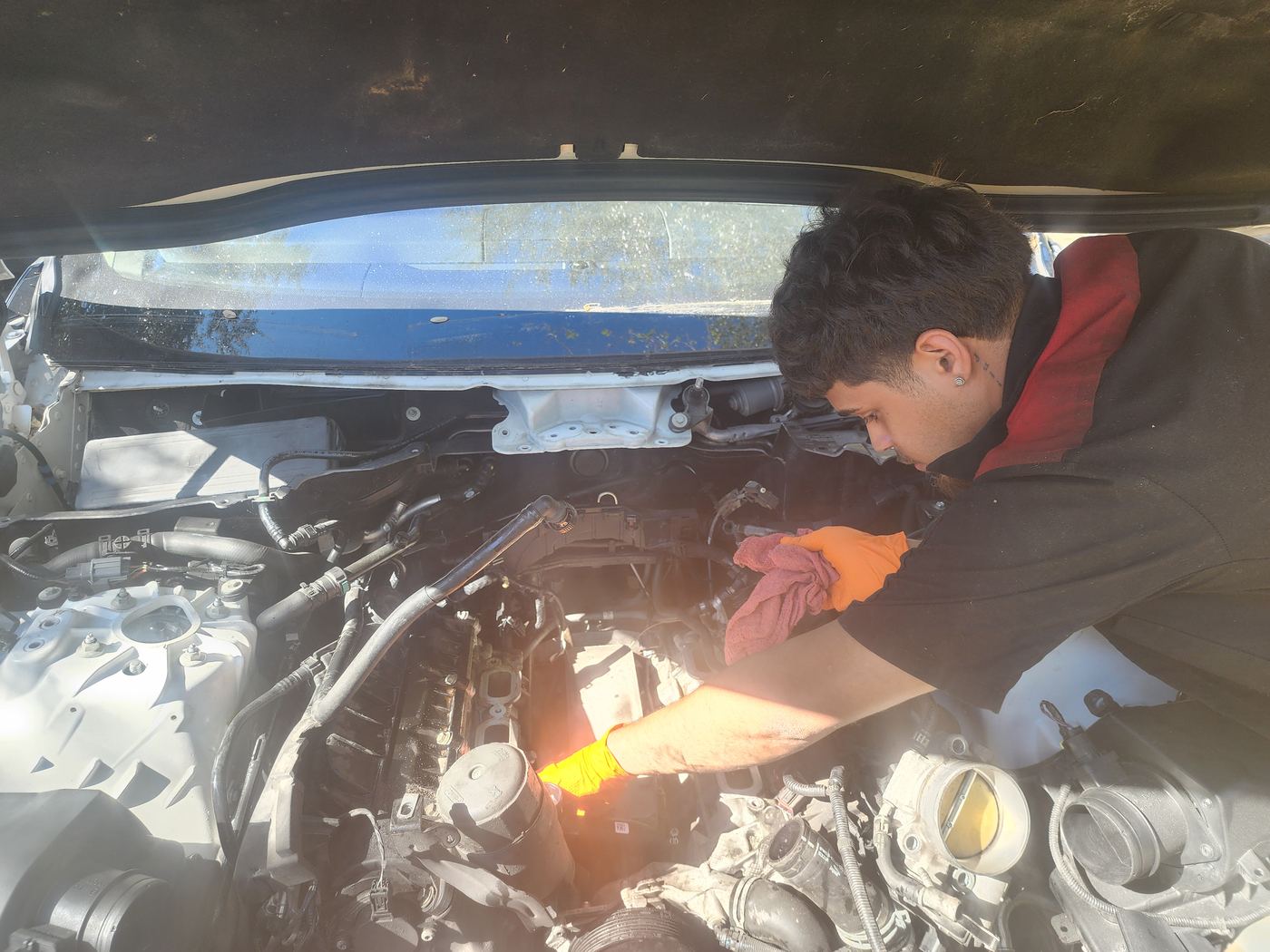
Our mobile A/C service runs that checklist at your home or office. We check pressures, watch the compressor engage, test the fans and pressure switches, and find leaks before adding anything.
The Musty Smell Is a Florida Special Too
Every time the A/C runs, water condenses on the evaporator inside the dash. That is normal, and it is why your car drips water under the passenger side. In Florida humidity, that damp box can start to smell.
A simple habit helps. For the last minute or two of a drive, turn the A/C off and leave the fan running. It dries the evaporator before the car sits in the sun. If the smell is already strong, it can be cleaned.
A/C that fades at red lights is also worth fixing before you sell or trade the car. It is one of the first things a buyer checks on a test drive in Orlando. Our guide to the 30-60-90 rule in Orlando covers testing the condenser fan as part of the bigger services.
Warm at idle? Call (407) 490-4147 and we will test it where it is parked.
Sources
- National Weather Service Melbourne, Orlando July Normals and Records and Orlando January Normals and Records, read October 18, 2026
- U.S. Environmental Protection Agency, Refrigerant Sales Restriction, read October 18, 2026
- U.S. Environmental Protection Agency, Motor Vehicle Air Conditioning, read October 18, 2026