Listen first. The sound your car makes when you press start tells you where to look, and it is often not the battery.
Keep Orlando's Finest in your Google results
Need It Fast?
- Fast clicking with dim lights points at the battery or a cable
- Bright lights and silence often means the shifter, brake or key fob
- A normal crank that never fires is not a battery problem
- A charged battery reads 12.6 volts or more at rest (Interstate)
- Jump it once, safely. AAA says stop after the third try
We get a lot of calls for cars that will not start. Most people open with the same line. "I think it's the battery." Sometimes it is. But the first thing to check is not the battery. It is the sound the car makes when you turn the key or press start.
That one sound sorts a no-start into a short list in about ten seconds. Below you'll find how to read it, the six checks to do in order from the driver's seat, and when to stop and call someone.
The First Thing to Check Is the Sound
Turn the key or press start one time and listen. Then look at the dash. Write down what you heard, because it is the most useful thing you can tell a mechanic on the phone.
| What you hear and see | What it usually points to |
|---|---|
| Fast clicking, dim or flickering dash | A battery too weak to spin the starter, or a loose or corroded cable. |
| One loud click, bright dash lights | The battery has power. Look at the starter, its relay or the cable to it. |
| Nothing at all, bright dash lights | The car is not asking the starter to run. Check the shifter, the brake pedal and the key fob first. |
| Nothing at all, no dash lights | A dead battery or a cable that came loose at the post. |
| Slow, dragging crank | A tired battery, or a starter working too hard. |
| Normal crank, engine never fires | Not the battery. Think fuel, spark or a security fault. |
The guides at the top of Google back up the pieces of this. Carfax says a car that will not crank with dim or dark interior lights likely has a dead battery. It says a car with working lights and horn that still will not crank, or that grinds, may have a bad starter. And it says no sound at all can mean a bad ignition switch or neutral safety switch.
That last row in the table is the one people miss. If the engine spins at its normal speed, your battery did its job. Buying a new one will not fix it.
Six Checks in Order, From the Driver's Seat
None of these need tools. Do them in this order, because the first ones are the cheapest to get wrong.
- Listen and look
One try. Note the sound and whether the dash lights stay bright, dim down or go out while you hold the key.
- Check the shifter and the brake
On an automatic the shifter has to be fully in Park. On a push button car your foot has to be on the brake. Honda's 2022 Civic manual says to check that the transmission is in P and press the brake before you press start. A shifter resting a hair out of Park will give you dash lights and dead silence.
- Try the steering wheel
A locked wheel can block the key. Honda's Civic Q and A page says that if the power mode will not change, the wheel may be locked, so move it left and right while you press the button.
- Think about the key fob
A weak fob battery can make a push button car act dead. Many cars have a backup. On the 2022 Civic, Honda says to touch the center of the start button with the H logo on the remote while the button flashes, then press the brake and the button within 10 seconds. Your owner's manual shows the spot for your car.
- Look at the fuel gauge and the security light
An empty tank is still a common no-start. Carfax notes that a tank very low on gas can fail to feed the engine when the car is parked on a steep slope. A security light that keeps flashing after you try to start can mean the car does not see your key.
- Look at the battery posts
Pop the hood. White or blue crust on the posts, or a cable you can twist by hand, is enough to stop a start. Do not touch both posts at once with a metal tool.
If those six all pass and the car still only clicks or stays silent, now the battery is the main suspect. Test it before you buy anything.
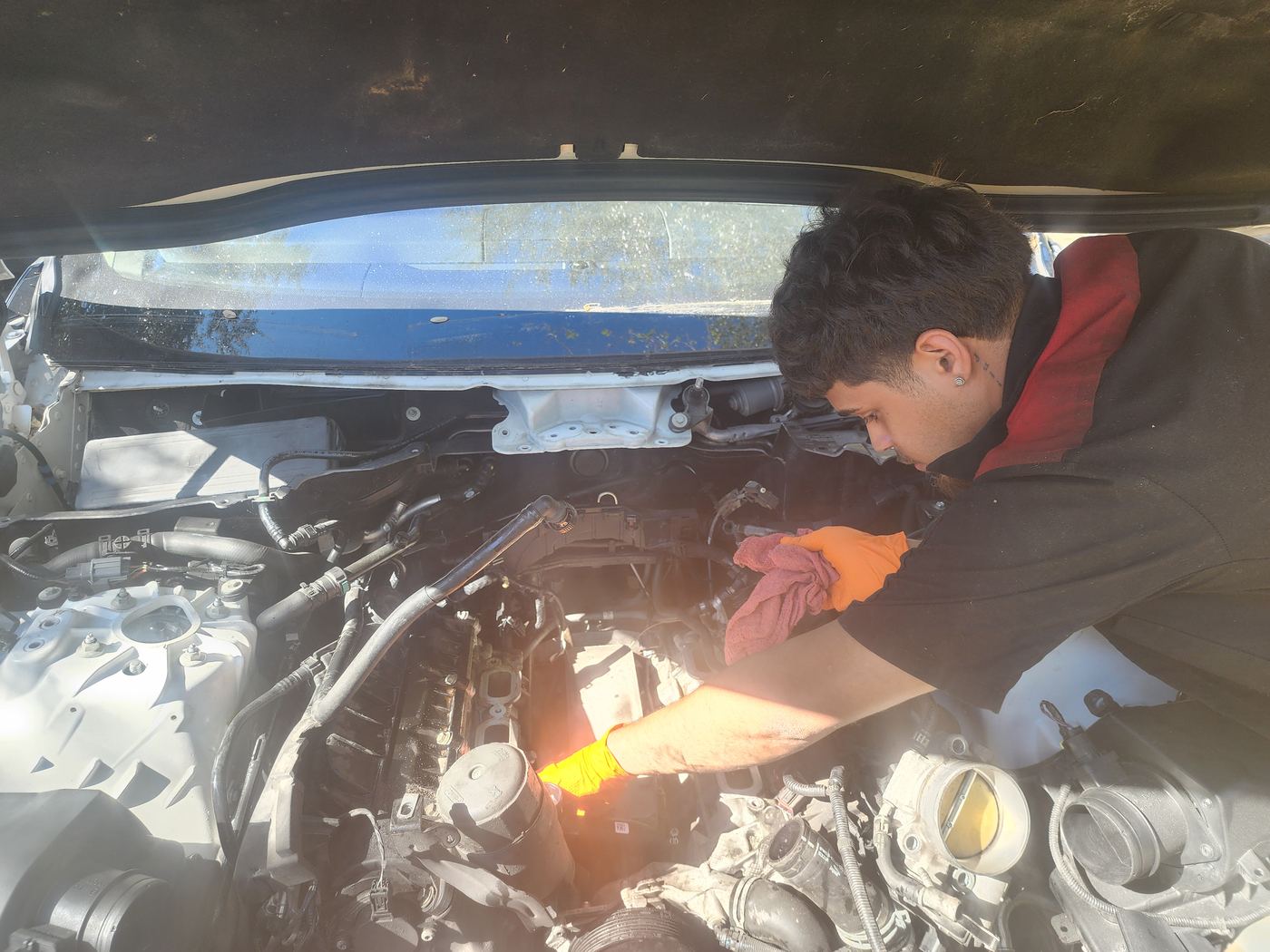
Test the Battery With Real Numbers
A cheap multimeter from any parts store answers the battery question for good. Interstate Batteries says to turn the headlights on for about two minutes first to burn off any surface charge, then turn them off, set the meter to the 20 volt range and touch red to positive and black to negative.
The readings mean this, per Interstate's battery FAQ and its testing guide.
What Your Battery Voltage Means
Volts, on a scale from 11 to 15.
Interstate is clear that a good resting number alone does not prove a battery is healthy. A battery can show 12.5 volts and still fall flat the second the starter pulls on it. That is why a shop runs a load test. But a reading under 12 volts ends the debate. That battery is empty.
If the car does start, check again with the engine running. A reading under 13 volts means the alternator may not be charging, and the same no-start will come back tomorrow.
Jump It the Safe Way, Once
If the battery reads low and the sound was fast clicking, a jump is a fair next step. AAA's jump guide has the safety points most people skip.
- Look before you clamp. AAA says a cracked or bulging battery, or a strong rotten egg smell, means you replace it instead of jumping it.
- Last clamp goes on bare metal. The final black clamp goes on a clean, unpainted bolt on the dead car's engine, not on the dead battery. AAA says that keeps the last spark away from battery fumes.
- Give it a few minutes. AAA says to run the good car for three to five minutes before you try the dead one.
- Stop after three tries. AAA says a car that still won't start after a third try likely has a completely failed battery.
- Drive it, then test it. A jump is not a charge. AAA says a steady 20 to 30 minute drive is usually needed, and a battery over three years old likely will not hold a charge overnight.
The part that matters most comes next. If the car jumped and ran, you found the battery side of the problem. If the jump changed nothing, stop jumping. You are now looking at a starter, a cable or a security fault, and more jumps will not find it.
Why So Many Orlando No-Starts Come Down to Heat
Central Florida is hard on batteries, and it does not give much warning. AAA says a battery typically lasts about three years in hot southern places, against five years or more in cooler northern ones. It also says to have the battery tested every year once it reaches its third year.
AAA South Jersey puts the ideal battery temperature at about 80 degrees and says heat speeds up the loss of fluid inside and the corrosion on the plates. In Orlando that is most of the year.
So if your battery is three years old and the sound was fast clicking, the odds are good you have your answer. We wrote the full story in why Florida heat kills car batteries.
Why Order Beats a Parts List
Most no-start advice online is a list of parts. Battery, alternator, starter, fuel pump, sensors. All true. None of them tell you what order to check things in, and that is what the question asks.
AutoZone's starter guide says the first thing to do is try a jump. That works when the car is clicking fast with dim lights. It wastes your time when the car cranks normally and will not fire, because the battery is already doing its job. It also skips the cheap stuff, like a shifter out of Park or a dead fob battery.
Our take is simple. Listen first, check the free things second, measure the battery third, and jump only when the first three point at it.
When to Stop and Call
Some no-starts are not driveway jobs for an owner. Stop and call for help if you see any of these.
- Smoke from under the hood or a burning smell when you press start. AutoZone says to put the key down and call a mechanic.
- A strong smell of raw gas.
- A battery that is cracked, swollen or leaking.
- A car that cranks normally on a full tank but never fires.
- A car that starts with a jump and dies again the next morning.
Before you pay for a tow, read mobile mechanic or tow it to a shop. A no-start is one of the few problems where the car is already parked right where the work can happen. Orlando's Finest Mobile Mechanic comes to the car for no-start diagnosis at your home, work or parking garage. Call (407) 490-4147.
Who Said So
- Carfax, 8 Reasons Your Car Won't Start, June 9, 2025, as of October 2026
- AutoZone, Signs of a Bad Starter, as of October 2026
- Interstate Batteries, How to Test a Car Battery with a Multimeter, as of October 2026
- Interstate Batteries, FAQs, as of October 2026
- AAA, How to Jump a Battery and Get Yourself Back on the Road, as of October 2026
- AAA, How Long Do Car Batteries Last, as of October 2026
- AAA South Jersey, The Silent Summer Threat, How Heat Wrecks Your Car Battery, as of October 2026
- Honda, 2022 Civic Sedan Owner's Manual, Starting the Engine
- Honda, 2022 Civic Sedan Owner's Manual, If the Keyless Remote Battery Is Weak
- Honda, 2022 Civic Sedan Owner's Manual, Q and A